MES Pricing Models Explained: Per User, Per Line, Per Site, and What They Actually Mean for You
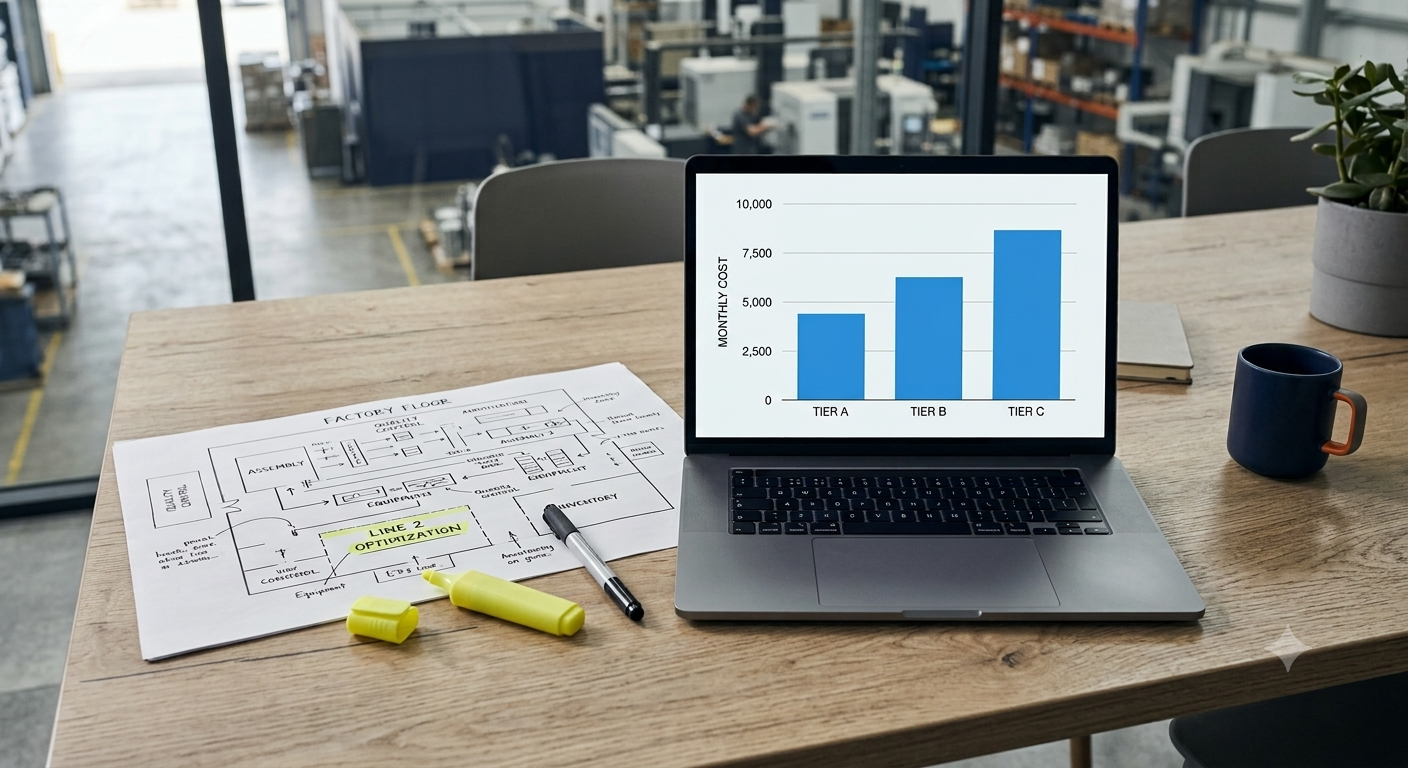
When you start looking at MES software, the pricing pages don't make it easy on you. Every vendor structures it differently, and half the time you can't actually tell what you're comparing until you're three sales calls deep. I've sat through enough of those calls myself, on both sides of the table now, to know the confusion is usually the point, not an accident.
So let's break down the models you'll actually run into. Not which one is "best," because that depends entirely on your plant. Just what each one means for a business your size.
Per user pricing: charged for potential, not use
This is the model most software companies default to because it's the model most software companies grew up on. You pay for every named login, sometimes every login that's active in a given month.
It sounds fair on paper. Use more, pay more. But manufacturing doesn't work in named seats. You've got machine operators rotating through three shifts, casual staff during peak season, supervisors who need occasional access, and a maintenance tech who logs in twice a week. Per user pricing charges you for all of that potential, whether or not it's realised, and it actively discourages you from giving floor staff access at all. The cheapest way to stay under budget is to lock terminals down to a handful of admin logins, which defeats half the reason you bought the system in the first place.
I've written more on this specific problem before, because it's the one that bit me hardest when I was running plants. If you want the full breakdown of where the hidden cost actually shows up, The Real Cost of Per-User Software Pricing covers it in detail.
Per station or per interface: pricing what's on the wall
Some vendors charge by the number of physical touchpoints instead of people. Think tablets on the line, terminals in the QA lab, a scanner at goods-in. This is more honest than per user in one way. It maps to something physical you can count and budget against, and it doesn't punish you for having more staff.
Where it gets tricky is scaling. Add a new line, add a new station, and your cost goes up in a way that's not always proportional to the value you're getting. A single interface shared across three shifts of operators can be excellent value. The same interface sitting mostly idle on a slow line is dead weight you're still paying for. It rewards you for consolidating touchpoints, which isn't always how a real floor is laid out.
Per site or per line: pay for footprint, not headcount
This model charges based on the physical footprint of your operation rather than people or devices. One fee per site, or one fee per production line, regardless of how many people log in or how many tablets are mounted on the wall.
For a mid-size manufacturer, this is usually the model that scales the way your business actually scales. You're not penalised for training more operators, running more shifts, or putting a terminal in every corner of the plant that would benefit from one. Your cost grows when your operation grows, not when your headcount does. It's also the easiest model to forecast, because it doesn't shift every time you have a good hiring quarter or a busy season with extra casuals.
The tradeoff is upfront cost. A flat site or line fee can look more expensive on day one than a lean per-user quote with three seats. But that comparison only holds if you plan to keep the system locked to three seats forever, which defeats the purpose of putting an MES in at all.
What actually matters when you're comparing quotes
None of these models is inherently a scam or a bargain. They're just different bets on how your business will grow. The question worth asking in any sales conversation isn't "what does it cost today" but "what does it cost in eighteen months, once this is actually rolled out properly across the floor."
Ask every vendor to walk you through their pricing at your current headcount and at double your current headcount. If they get uncomfortable answering that, you've learned something important before you've signed anything.
Further reading
If per-user pricing is the model you're currently stuck evaluating, The Real Cost of Per-User Software Pricing goes deeper into exactly where that cost hides and why it tends to surface later than you'd expect.